RG2-hNIS
- Frozen / Standard (CL016-STAN) $ 1,500
Species: Rat
Cell type: Glial tumor
Transgene: Human sodium iodide symporter (hNIS)
Media: DMEM, 10% FBS, 1% Pen/Strep
Description: RG2-hNIS is a polyclonal population of the rat glial tumor RG2 cell line transduced with LV-hNIS (LV001) encoding the human sodium iodide symporter (hNIS) cDNA under the spleen focus-forming virus (SFFV) promoter.
The lentiviral vector used is a self-inactivating (SIN) vector in which the viral enhancer and promoter has been deleted. Transcription inactivation of the LTR in the SIN provirus increases biosafety by preventing mobilization by replication competent viruses and enables regulated expression of the genes from the internal promoters without cis-acting effects of the LTR (Miyoshi et al., J Virol. 1998).
Recommended uses:
In vitro: This is a high hNIS expressing clone suitable for use as a positive control cell line in I-125 uptake assays to validate NIS expression in your lentiviral transduced cells.
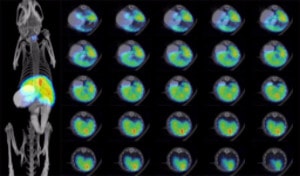
In vivo: This rat glial tumor cell line grows as a glioma after intracranial injection into Fisher 344 rats. Once large it’s growth can be monitored noninvasively using high-resolution 3D SPECT or PET imaging due to disruption of the blood-brain-barrier allowing for radioiodine access to the tumor cells.
Note: disrupting the blood-brain barrier with mannitol treatment may allow for NIS imaging at early stages of tumor formation.
Morphology: Low- and high-density cell morphology (200x)

NIS Function Assay (Iodine Uptake): Cells were incubated with 125I for 1h in the presence or absence of KClO4, an inhibitor of iodine uptake. Radioiodine concentrated within the cells was measured with a gamma counter.

References on NIS imaging:
1. Fruthwirth et al. A whole body dual modality radionuclide optical strategy for preclinical imaging of metastasis and heterogeneous treatment responses in different. microenvironments. J. Nucl. Med 2014. 55(4): 686-94.
2. Penheiter et al. The sodium iodide symporter (NIS) as an imaging reporter for gene, viral and cell-based therapies. Curr Gene Ther. 2012, 12(1):33-47.